Hyper liquid funding rates determine which side pays at each hourly settlement
last updated
Hyper liquid funding rates determine hourly transfers between perpetual longs and shorts: positive rates charge longs, while negative rates charge shorts. The amount depends on the position held at settlement, its oracle-price value and the applicable hourly rate. Before treating an expected receipt as a reason to hold exposure, confirm the quoted rate’s interval and distinguish the market estimate from an actual account payment. Price losses and execution costs can outweigh the funding received.
Bottom line: Funding receipts can accompany a losing position because price changes and trading costs also affect the account.
Premium and Interest Components
The premium measures the relationship between order-book impact prices and the oracle, while the interest component supplies a financing adjustment. Their combination determines funding. Impact prices reflect average execution across a specified quantity, so the latest trade alone cannot reproduce the premium.
Current Rates and Account Payments
The perpetuals API separates current market context, historical market rates and account-specific funding payments. These records answer different questions. Current context describes the market; rate history describes past intervals; account history identifies a particular account’s funding entries.
The relevant query types are metaAndAssetCtxs, fundingHistory and userFunding. An account entry includes the market, timestamp, position size, funding rate and payment amount. Match these fields before interpreting a balance movement as funding. A market-wide rate does not establish whether a particular account held exposure.
Parameters Behind the Payment
The payment calculation requires compatible position units and the correct settlement interval. These parameters describe the ordinary linear perpetual mechanism; market-specific settings still determine the applicable funding rate.
| Parameter | Documented Value | Calculation Role | Required Position Context |
|---|---|---|---|
| Payment interval | 1 hour | Settlement frequency | Exposure at settlement |
| Formula time basis | 8 hours | Conversion to hourly funding | The quoted rate’s interval |
| Ordinary contract unit | 1 underlying asset unit | Position quantity | Matching contract specifications |
| Notional valuation input | Oracle price | Position value for funding | Matching market and settlement |
Ordinary contracts use linear exposure without a scheduled expiration. Funding supplies a recurring price-alignment mechanism throughout the position’s life. Contract quantity therefore remains relevant even when collateral or leverage changes.
How Is the Hourly Payment Calculated?
The payment magnitude equals absolute position size multiplied by the settlement oracle price and the absolute hourly funding rate expressed as a decimal.
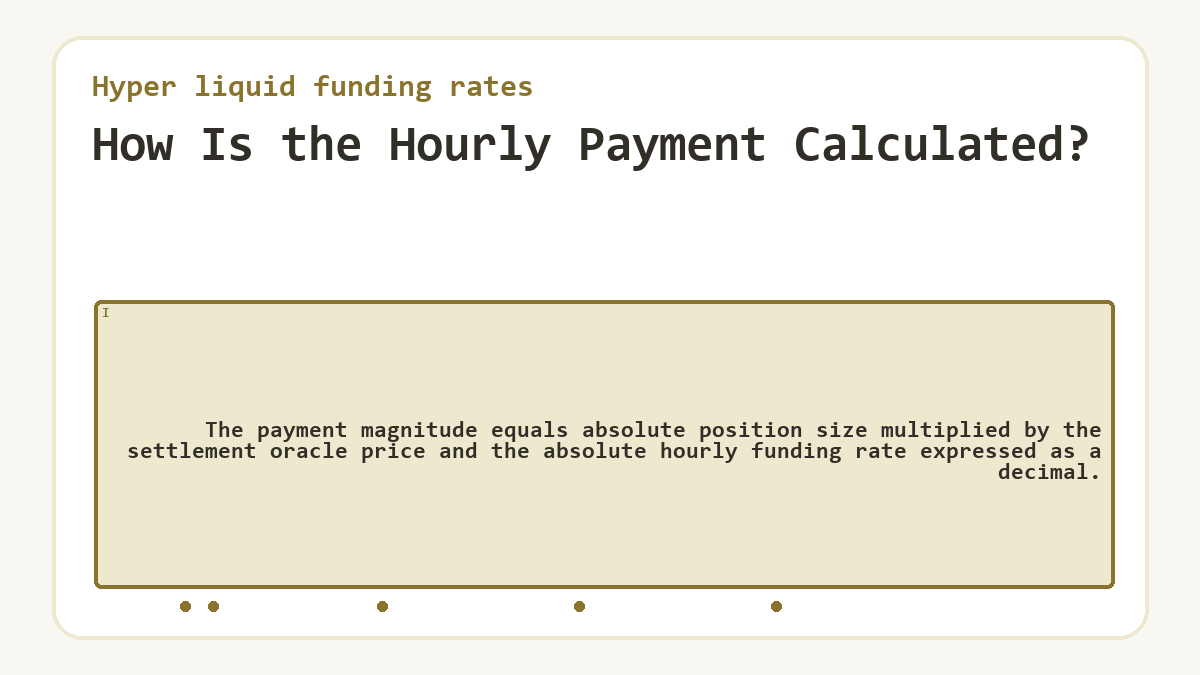
Hourly settlement uses one eighth of the rate calculated on the eight-hour basis. An already-hourly rate needs no further division. Apply the sign separately to identify payment direction. Funding transfers carry no additional collection fee.
Oracle Price and Mark Price
The mark price determines unrealized profit, margin calculations and liquidation conditions, whereas the oracle supplies the funding valuation input. These prices have related inputs but different purposes. A displayed position value based on the mark can therefore differ from the value used for funding.
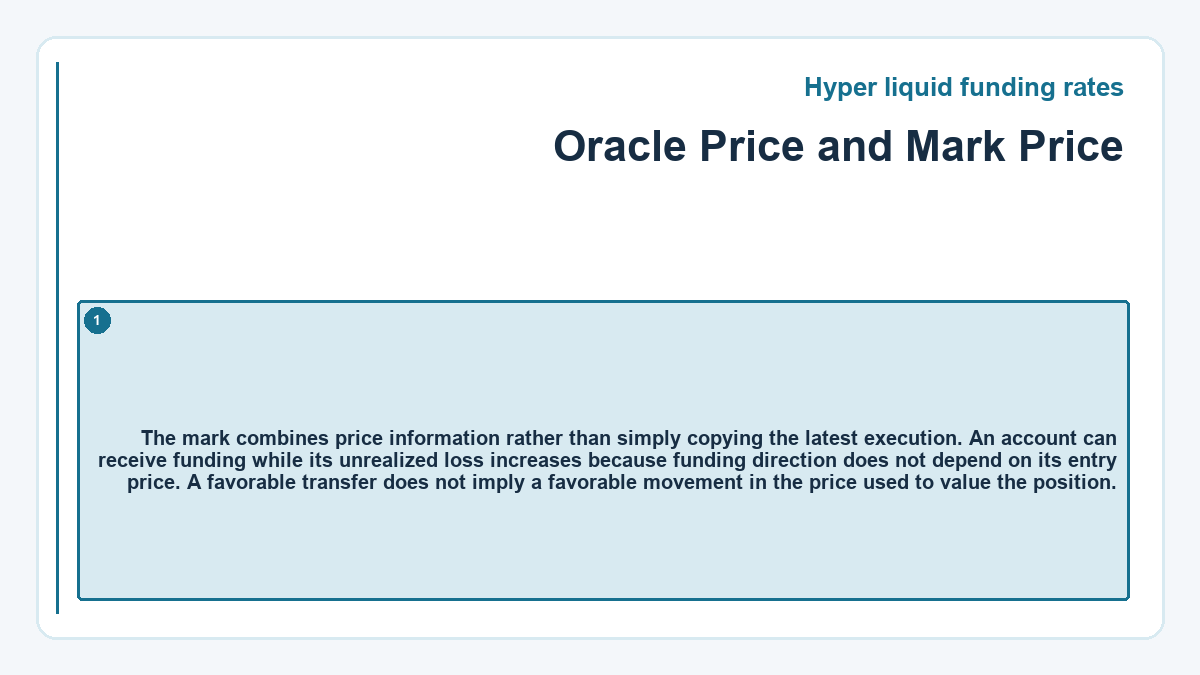
The mark combines price information rather than simply copying the latest execution. An account can receive funding while its unrealized loss increases because funding direction does not depend on its entry price. A favorable transfer does not imply a favorable movement in the price used to value the position.
Leverage and the Available Margin Buffer
Leverage changes the initial margin required for a given position, rather than changing the underlying quantity by itself. The initial margin calculation uses absolute position size multiplied by mark price, divided by the selected leverage.
Consequently, the same position can represent a larger exposure relative to its supporting collateral. A payment assessed on that exposure can consume a larger share of a smaller margin buffer.
Cross margin shares collateral within the applicable pool. Account configuration determines whether positions across different perpetual venues share that pool. Under unified accounts, compatible cross positions using the same collateral share margin; standard accounts retain venue-level separation.
Isolated margin confines support to the particular position. These arrangements change which funds absorb losses, so an account-wide balance cannot describe every position’s remaining buffer. Maintenance requirements continue to apply while funding accrues.
Execution Charges Around a Funding Payment
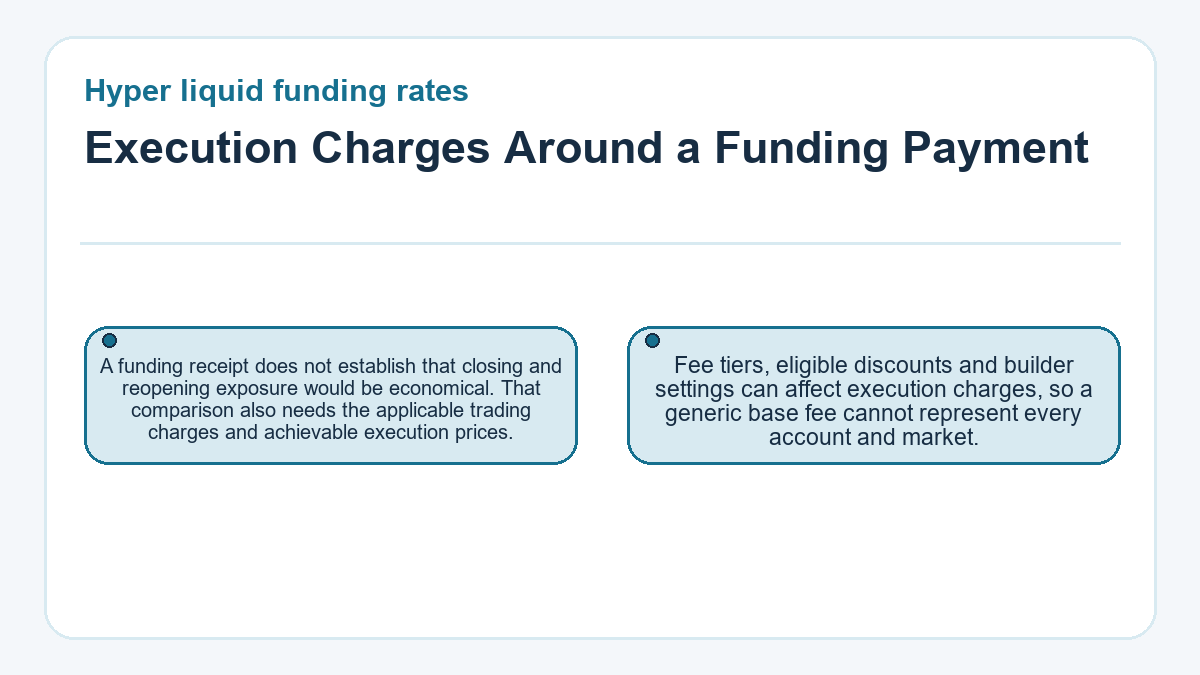
Trading fees depend on executed trades and the applicable maker or taker schedule. Funding and execution charges therefore belong on separate lines when evaluating the cost of holding a perpetual position.
A funding receipt does not establish that closing and reopening exposure would be economical. That comparison also needs the applicable trading charges and achievable execution prices. Fee tiers, eligible discounts and builder settings can affect execution charges, so a generic base fee cannot represent every account and market.
Annualized Figures and Holding Periods
An annualized funding figure extrapolates a periodic rate across a year under stated assumptions. It expresses a calculation, rather than fixing the payments a position will receive.
Simple annualization multiplies the periodic rate by the number of matching periods. A compounded figure assumes reinvestment as well. Comparing those figures without distinguishing their methods can create an apparent difference which comes entirely from arithmetic.
For a finite holding period, the relevant calculation sums the payments across its settlements. Multiplying a single observation by the whole period assumes the rate and position value stay unchanged. That assumption needs to remain visible beside the estimate.
Historical variation helps describe the uncertainty: persistence, reversals and isolated spikes have different implications for an extrapolation. None establishes the next settlement’s outcome. A large annualized number can originate from a brief observation.
Builder-Deployed Funding Settings
Builder-deployed markets can use configurable funding multipliers, interest components and clamps. The multiplier scales funding, while the clamp bounds the adjustment toward the interest component. A standard-market setting therefore cannot automatically describe every builder-deployed contract.
The operator API exposes separate actions for these controls. Reconstructing a rate requires the selected market’s applicable configuration; copying constants from another contract can produce internally consistent arithmetic with the wrong result.
Market operators also define their contracts and oracle arrangements. That makes the reference price part of the holding decision: similar-looking rates can relate to different underlying exposure or reference-price behavior. Identifying the actual contract comes before comparing its expected carrying cost.
Why Can a Funding Record Differ From an Estimate?
A funding record can differ because the estimate used another rate observation, position size, valuation price or settlement interval. Compare those inputs before attributing the difference to an incorrect charge.
Account history and market history require compatible market identifiers and time windows. The API accepts millisecond timestamps with inclusive boundaries. Overlapping exports can therefore include the same boundary record twice. A complete interval comparison needs unique records, rather than a sum of every row collected.
Funding as a Holding Constraint
A funding comparison needs both the expected carrying cost and the exposure retained to earn or pay it. Continuing a position retains price risk; changing it introduces execution costs. If the rate’s interval, contract configuration or available margin is unknown, wait before opening or adding exposure. For an existing position, compare its funding cost and price risk with your chosen limits to decide whether to hold, reduce or close it. Waiting with an open position does not pause funding or price risk.
After reducing or closing exposure, check the remaining position size to confirm the result. A payment history can establish what the account paid or received during a defined period. It cannot establish that the same terms will persist, or that future receipts will cover an adverse price movement.
What to know about Hyper liquid funding rates
Does a Trading Fee Discount Reduce Funding Payments?
A trading fee discount changes eligible execution charges, rather than the funding calculation. Maker and taker fees use the account’s applicable fee schedule. Funding uses the position and market funding inputs, so a lower trading fee does not imply cheaper funding.
Are Funding Predictions Available for Every Perpetual Venue Through the API?
The predictedFundings query supports the first perpetual DEX, rather than every builder-deployed venue. Absence from that response does not establish a zero funding rate.
How Does a hyperp’s Funding Reference Differ From an Ordinary Perpetual?
A hyperp uses a moving average of its mark price in place of the ordinary external spot or index reference. Its funding mechanism therefore relates to that contract-specific reference. A calculation assuming an external spot oracle cannot automatically describe a hyperp.
Can a Builder Set a market’s Funding Multiplier to Zero?
The builder configuration permits a zero funding multiplier. That setting scales the funding rate to zero, but does not remove the position’s price exposure or execution charges. It is a configurable market setting, rather than a permanent promise about future funding.
When Does Operator Settlement End a builder-deployed position’s Future Funding Exposure?
Operator settlement ends that position when the haltTrading action settles it at the current mark price. The action also cancels outstanding orders. The same mechanism can later resume trading, so an old funding history does not prove continuous exposure across a settlement.